
Let’s dig into the factors that impact how much your pet insurance costs.
At Lemonade, a policy for a dog or a cat starts at $10/month. (Plus our affordable pet insurance has won the approval of authorities like Money.com).
But the cost of pet insurance coverage can vary depending on several factors, including the amount and type of coverage you choose, the breed and age of your furry family member, and where you live. It’s a small price to pay to be prepared for the unexpected.
Let’s skip the complicated insurance jargon, and look at how much pet insurance actually costs.
What’s the average cost of pet insurance?
The prices of pet insurance plans can vary significantly, depending on a bunch of different factors, so we decided to check rates for a typical cat and a typical dog at six different insurance companies.
How much is pet insurance for dogs?
Let’s look at an example: If you have a 4-year-old Goldendoodle in Chicago enrolled in a plan with 80% co-insurance, the maximum annual limit available, and an annual deductible of $250, you’ll pay an average of $61/month.
| Insurance Provider | Average Monthly Cost |
| Trupanion | $336 |
| Healthy Paws | $85 |
| Pets Best | $77 |
| Many Pets | $73 |
| Fetch | $99 |
| Lemonade | $61 |
On average, across different ages, breeds, and locations, Lemonade pet parents pay around $48/month to keep their pups covered.
How much is pet insurance for cats?
We got a pet insurance quote for a 1-year-old, short-haired cat in Danbury, Connecticut. We picked the base policy offered by six different pet insurance companies, and adjusted the coverages as much as we could to include a $250 deductible, 80% co-insurance, and the maximum annual limit available, with no add-ons or discounts. With this kitty and these policy details, you’ll pay an average premium of about $34/month.
Please note: we built these quotes to be as identical as possible, but there are a few coverage differences to note. For example, Trupanion only offered a 90% co-insurance option. We standardized the offerings as much as possible.
| Insurance Provider | Average Monthly Cost |
| Trupanion | $58 |
| Pets Best | $35 |
| Many Pets | $44 |
| Fetch | $36 |
| Lemonade | $29 |
On average, across different ages, breeds, and locations, Lemonade cat parents pay around $27/month to keep their kitties covered.
How much is pet insurance in my state?
Curious how your location affects the cost of pet insurance? Check out the average monthly cost of Lemonade pet insurance for both dogs and cats, so you can get a quick sense of what to expect.
| State | Average monthly cost of pet insurance* |
| Alabama | $30 to $34 |
| Arizona | $35 to $39 |
| Arkansas | $30 to $34 |
| California | $45 to $49 |
| Colorado | $40 to $44 |
| Connecticut | $45 to $49 |
| DC | $40 to $44 |
| Florida | $35 to $39 |
| Georgia | $30 to $34 |
| Illinois | $40 to $44 |
| Indiana | $30 to $34 |
| Iowa | $25 to $29 |
| Louisiana | $21 to $36 |
| Maryland | $40 to $44 |
| Massachusetts | $40 to $44 |
| Michigan | $30 to $34 |
| Minnesota | $23 to $47 |
| Mississippi | $25 to $29 |
| Missouri | $30 to $34 |
| Montana | $30 to $34 |
| Nebraska | $30 to $34 |
| Nevada | $30 to $34 |
| New Hampshire | $45 to $49 |
| New Jersey | $35 to $39 |
| New Mexico | $25 to $29 |
| New York | $40 to $44 |
| North Carolina | $35 to $39 |
| North Dakota | $25 to $29 |
| Ohio | $30 to $34 |
| Oklahoma | $20 to $24 |
| Oregon | $40 to $44 |
| Pennsylvania | $30 to $34 |
| Rhode Island | $25 to $29 |
| South Carolina | $30 to $34 |
| Tennessee | $30 to $34 |
| Texas | $30 to $34 |
| Utah | $30 to $34 |
| Virginia | $40 to $44 |
| Washington | $35 to 39 |
| Wisconsin | $35 to $39 |
What factors impact my pet insurance costs?
Several factors impact your pet insurance quote:
Cat vs. dog
Cats are usually cheaper to insure than dogs because medical costs are generally cheaper for cats. Cats live longer than dogs, and while both will require vaccinations and exam fees throughout their lives, cats tend to have fewer health problems. Many cats stay inside, so they’re less exposed to risks that could lead to an accident or an illness than a dog is. Dogs are also more prone to hereditary conditions like hip dysplasia or issues with a cruciate ligament.
Age
Like older people, older pets tend to need more healthcare. When you purchase pet insurance your pet’s age will impact your monthly premium.
Breed
Certain dog breeds and cat breeds are naturally more costly to take care of than others. So if you know your cat is more likely to develop a hereditary condition like asthma because she’s a Siamese, should you assume it will be considered a pre-existing condition? Not exactly.
Your pet may not show signs of these medical conditions at birth, or in the first few years of their life. But if you wait until they develop symptoms to get insured, the condition probably won’t be covered by your policy. If you insure your pet when they’re still young and symptom-free, though, pet insurance could help cover the vet bills to treat their chronic condition-which could be a real game changer.
Location
Your pet insurance rate can also change depending on where you live, since vet care is more expensive in some states than others. For example, medical costs in California are higher than they are in Tennessee.
That could also mean you’re being charged more for a vet visit. While this wouldn’t affect your monthly premium, it may affect how quickly you reach your annual limit, so make sure you customize your pet insurance policy so it’s worth it for you.
Calculate your estimated savings as a pet owner with pet insurance
Wondering if pet insurance is worth it? Check out how much pet parents of dogs and cats have saved on vet bills by signing their fur baby up for pet insurance.
How Much Could You Spend on Vet Bills This Year?
Dog/Cat Breed
Pet Age
State
How can I lower my pet insurance premium?
You might be able to lower your monthly cost by adjusting your co-insurance, deductible, and annual limit on your pet insurance policy. In most states*, you can request coverage downgrades such as increasing your deductible or decreasing your co-insurance at any time during the policy period. We bet you’d appreciate an explanation of what those things all are, and the available options:
Co-insurance
Co-insurance (which is not the same thing as a co-pay) is the percentage of the total cost your insurance company will pay on a claim. So if the co-insurance you chose is 80%, then the company pays for 80% of covered costs when your pet gets veterinary care, and you pay the other 20%.
Keep in mind that this is applied to every claim. With Lemonade pet insurance, for example, you can pick either a 70%, 80%, or 90% co-insurance.
Deductible
Another way you participate in the cost of your claim is your deductible. You choose this amount-at Lemonade, it’s either $100, $250, $500, and $750.
The higher your deductible, the lower your monthly premium will be. Keep in mind: If you increase your deductible, it increases the amount you are responsible to pay out-of-pocket in the future. So before choosing a deductible, ask yourself-What amount of my pet’s medical expenses could I cover myself before I need help from my insurance company?
Your pet insurance policy has an annual deductible, which means you can exhaust it in one big claim, or use it up over multiple claims throughout the course of a year.
Annual limits
Most pet insurance providers have a limit to the payouts they can provide, but the good news is, you get to pick what that limit is. At Lemonade, you can choose an annual limit anywhere between $5,000 and $100,000. Your medical bills for your fur fam can add up quickly, so make sure your insurance coverage is the right fit for your budget and your pet.
You might be able to lower your premium by 10% or 15% by making one of these changes, but don’t forget that while adjusting these reimbursement levels can help lower your monthly payments, it’ll mean you’re covered for less when an expensive vet bill rolls in.
To explore your coverage options, shoot us an email at If you’d rather chat over the phone, give us a call
How do pet insurance claims work?
Still confused about what actually happens when you file a claim? We’ve got you. Let’s walk through an example, nice and slow.
- Your dog, Mogley, needs knee surgery. Poor guy!
- The procedure costs $6,000, so you file a claim for that amount
- Your policy includes 80% co-insurance and a $250 deductible
Here’s how your claim payment would be calculated:
($6,000 x 80%) – $250 = $4,550
Since your insurance company would pay $4,550 towards this claim, you and Mogley would be responsible for the remainder-in this case, $1,450 (that amount includes the $250 deductible).
Now let’s say a few months later you have to file another claim, after Mogley swallows a mysterious object. The resulting procedure costs $1,500. Since you already paid your deductible for the year, here’s what your claim calculation would be:
($1,500 x 80%) – $0 = $1,200
You’d only need to pay $300 for the procedure (the $1,500 bill minus the $1,200 your insurance company contributes). This is how your claims would work for the rest of the year until you reach your annual limit.
What vets are accepted by pet insurance?
Since Lemonade Pet works on a reimbursement basis, you can take your pet to any vet you’d like in the U.S., as long as they’re licensed to provide veterinary care in the state they operate in.
You’d pay the bill for your pet’s care or treatment upfront, then submit those receipts to us in the Lemonade mobile app for reimbursement. Our claims team will review to make sure the situation you’re claiming is covered under your policy, and reimburse you for the amount you’re eligible for on the claim.
How can pet insurance reduce my vet costs?
Having pet insurance means you can avoid having to ask yourself whether you can afford the treatment out-of-pocket that your pet needs to live their best life.
A standard pet insurance policy will help cover the costs of diagnostics, procedures, and medications to treat your dog or cat’s eligible accidents and illnesses.
That means something like a broken leg or an injury from a car accident could be covered, as could a mysterious stomach bug. If your pet experiences an injury, vomiting, diarrhea, infections, cancer, or many other illnesses that we hope never plague them, a basic policy will help cover the costs of:
- Diagnostics: Blood tests, x-rays, MRI’s, CT scans and lab work
- Procedures: Outpatient, specialty and emergency care, hospitalization and surgery
- Medication: Injections or prescription meds
A basic policy will cover you for a lot of your pet’s health-related expenses, but not everything. That’s why pet insurance companies offer add-ons.
What are add-ons?
If you want to maximize your coverage, Lemonade offers comprehensive preventative care options, with specific coverage depending on your state, that can help with your pet’s needs from puppyhood through their senior years.
Preventative care can include coverage for procedures like spaying/neutering, microchipping, and heartworm and flea medication that help set your pet up for a healthy life.
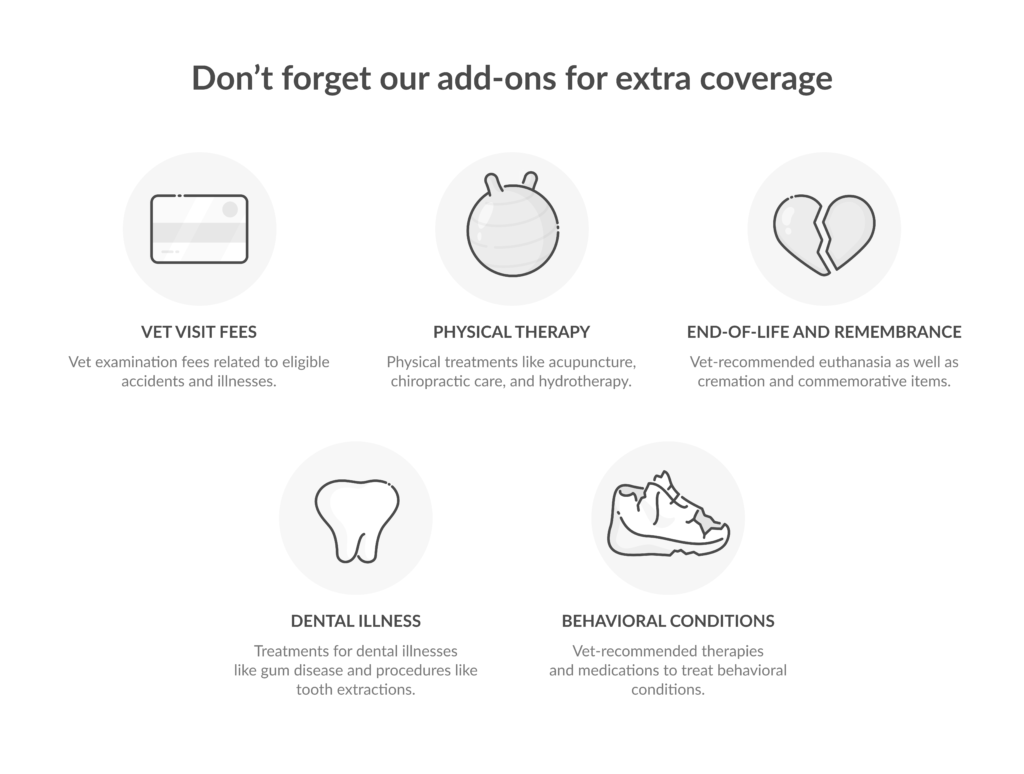
In addition, Lemonade Pet offers optional add-ons that you can mix and match on your policy. Here’s what they can help cover:
- Visit fees: Fees vets might charge for their time and labor when you bring your pet in after an accident or illness.
- Physical therapy: Physical therapy, acupuncture, and hydrotherapy to help your pooch through the recovery process.
- Dental coverage: Help with dental illness treatments and procedures. Depending on your location, you may also have access to comprehensive dental coverage that includes routine cleanings and covers pre-existing dental conditions.
- Behavioral conditions: Vet-recommended therapy and medications for behavioral conditions like anxiety and aggression.
- End of life and remembrance: Vet-recommended euthanasia, as well as cremation, and commemorative items to memorialize your pet.
What does pet insurance not cover?
Pet insurance can cover A LOT, but of course there are some exclusions to keep in mind. For example, your pet insurance won’t cover:
- Pre-existing conditions: Anything that shows up in your pet’s medical history from before your policy was active, or during your policy’s waiting period.
- Preventable situations and neglect: If a pet parent isn’t providing a safe environment or a reasonable standard of preventative care for the pet, it could be considered neglect. If that neglect results in a health issue, it probably won’t be covered. For the record, we’re sure you’re not neglecting your pet, and we hate thinking about this one, too!
- Certain things not related to an accident or illness: Things like grooming; other elective cosmetic procedures (like giving your cat a fancy haircut); obedience training; and boarding/travel
The truth is, pet insurance isn’t cheap, but neither is the cost of keeping your pet healthy.
If you’re not sure whether pet insurance is worth it, imagine the worst-case scenario-and whether you’d have the money put aside to cover the medical costs.
Lemonade’s pet insurance policies are customizable for a reason. If you can’t pay $90 every month for a policy with 90% co-insurance, that’s OK. We’ve made it so you can change your coverage to set a monthly price that suits your budget.
In our unpredictable world, it’s even more important to protect the ones you love-so you don’t have to make a tough decision down the road.
FAQs
How much should I be spending on pet insurance?
How much of my vet bills does pet insurance cover?
Does the cost of pet insurance increase as my pet ages?
Is pet insurance worth it?
Other questions pet parents ask us:
How much does pet insurance cost per month on average?
Is pet insurance cheaper for cats or dogs?
What factors determine my pet insurance premium?
How can I lower my monthly pet insurance payments?
Is pet insurance worth the cost for a young, healthy pet?
Does pet insurance cover pre-existing conditions?
Reddit asked, we answered
How much do you pay monthly for your pet insurance?
Is pet insurance worth it, and how much does it typically cost?
What are you paying for pet insurance? And through whom?
How much do you pay for puppy/dog insurance?
How much is everyone paying for their pet insurance?
In which states does Lemonade currently offer pet health insurance?
Alabama, Arizona, Arkansas, California, Colorado, Connecticut, Delaware, Florida, Georgia, Hawaii, Illinois, Indiana, Iowa, Louisiana, Maryland, Massachusetts, Michigan, Minnesota, Mississippi, Missouri, Montana, Nebraska, Nevada, New Hampshire, New Jersey, New Mexico, New York, North Carolina, North Dakota, Ohio, Oklahoma, Oregon, Pennsylvania, Rhode Island, South Carolina, Tennessee, Texas, Utah, Virginia, Washington, Washington, D.C. (not a state… yet), and Wisconsin.
